| INTRODUCTION |
|
The National Cadet Corps was formed in India with the National Cadet Corps Act of 1948, with the purpose of recruit regular students as cadets for basic military training in small arms and parades during their study. From high schools, colleges and Universities all over India on voluntary basis.
Once they complete their NCC training, they are given preference over normal candidates during selections based on the achievements in the active military service, various other services and also in admission in the higher education.
|
| Motto of NCC : Unity and Discipline (Ekta aur Anushasan) |
Four Cardinal Principals of Discipline :
- Obey with a smile
- Be Punctual
- Work hard and without fuss
- Make no excuses and tell no lies
Aims of NCC :
- To develop qualities of character, courage, comradeship, discipline, leadership, secular outlook, spirit of adventure and sportsmanship and the ideals of selfless service among the youth to make them useful citizen.
- To create a human resource of organized trained and motivated youth to provide leadership in all walks of life including the Armed Forces and be always available for the service of the nation.
|
| Oath :
"I do hereby solemnly promise that I will serve my motherland most truly and loyally and that, I will abide by the rules and regulations of the National Cadet Crops. Further under the command and control of my commanding officer I will participate in every camp most sincerely and wholeheartedly."
|
| NCC Organisation |
The National Cadet Corpos is headed by a Director General, an Army Officer of the rank of Lt. General, who is responsible for the functioning of the National Cadet Corps in the country through the National Cadet Corp Headquarters situated at Delhi. The organizational structure of NCC is as under:
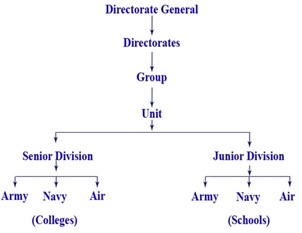
|
Ranks of cadets in Senior Division NCC :
-
Army wing
- Senior Under Officer
- Cadet Under Officer
- Company Quarter Master Sergeant
- Sergeant
- Corporal
- Lance Corporal
|
| Basic Trainings |
• Drill
- Cadets must be made to understand the aim and purpose of teaching drill, so that they are suitably motivated and do not take it as "fatigue". Emphasis will be laid on correct bearing, marching, saluting and arms drill. Inter-squad competitions may be organized to create interest.
• Weapon Training
- Cadets generally take keen interest in weapon training and firing. Units must liaise with nearby Service and Para-Military Units to ensure that all cdts get an opportunity to fire their authorized arm. Use of firing simulators may be made to optimize target efforts where possible.
• Adventure Training
- Adventure activities have been incorporated in NCC training with the aim of inculcating and strengthening leadership traits amongst the cadets. These activities in NCC can be broadly divided into the following.
- Land based - Mountaineering, Rock Climbing, Trekking
- Water based - Sailing Expedition, White Water Rafting, Scuba Diving, River Crossing.
- Air based - Parasailing.
|
Youth Exchange Programme :
- This is a very important activity. It is done to increase international understanding and bolster awareness. These exchanges are done with NCC community of 10 countries namely Australia, Bangladesh, Bhutan, Canada, Maldives, Nepal, Singapore, UK, Russia and Vietnam at international level.
|
| NCC Camps :
The participation in caps is compulsory for appearing in NCC examination. Major NCC camps are as under:
- Leadership Camp
- ThalSainik Camp
- VayuSainik Camp
- NauSainik Camp
- Rock Climbing Camp
- Trekking camp
- National Integration Camp (NIC)
- ThalSainik Camp (TSC)
- Army Attachment Camp (AAC)
- Air force Attachment Camp (AAC)
- Ship Attachment Camp
- Republic Day Camp (RDC)
- Annual training Camp(ATC)
|
| Certification Programme |
| General
The eligibility conditions and the general procedure for the conduct of the Certificate Examination for Cadets of Senior and Junior Division/Wings NCC(All wings) have been issued by this HQ from time to time. The aim of this Directive is to consolidate all such instruction and revise these, where necessary.
Type of Examination :
The type of Certificate Examination and the unit in which these are held are given below :
- Certificate 'B' & 'C'
- Senior Division NCC
|
| For "B" Certificate Examination |
- Cadet must be in second year of SD/SW NCC Training
- Must have attended one Annual Training Camp/NIC/Attachment training with regular Army, Navy, Air Force Units.
- The cadet must have attended a minimum of 75% of total training period laid down in the syllabus for the first and second years for Senior Division Wing NCC (All Wings). Break in the NCC service of the cadet SD/SE prior to appearing in the exam should not exceed more than 18 months at one time, after his discharge to count his service for Certificate 'B' Examination. In case the break exceed 18 months the following procedure will be adopted.
"If he had been on the unit rolls for a minimum of two years before his discharge and had attended 75% of the total periods during his NCC service he will need another 45 periods of training to become eligible for certificate 'B' Examination. In all other cases where above conditions are not fulfilled, the cadet must attend a minimum 75% periods of the first and second years of training."
|
| For "C" Certificate Examination |
- Cadet must have passed 'B' certificate.
- The Cadet must be in second/third year of SD/SW NCC Training
- The Cadet must have attended a minimum of 75% of the periods of 3rd year syllabus during the academic session.
- Break in the NCC Service of the SD/SW Cadet prior to appearing in the exam should not exceed more than 18 months at one time, after his discharge to count his previous service for Certificate 'C' examination. In case the break exceeds 18 months, the following procedure will be adopted.
"If he had been on the Unit rolls for a minimum of two years before his discharge and had attended 75% of the total period during his NCC service, he will need another 45 periods of training to become eligible for Certificate 'C' examination. In all other cases where above conditions are not fulfilled, the Cadet must attend a minimum of 75% periods of the first and second year of training."
- Must have attended two Camp.
|